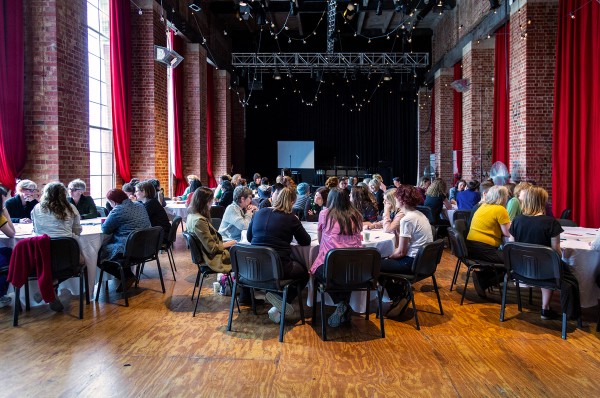
This recording is from the inaugural Hi-Viz Practice Exchange in 2018 held at The Substation.
Panel Discussion Two: Organising Principles.
Composers Kate Neal and Madeline Flynn, and theatre makers Emma Valente and Kate Sulan discuss composition, dramaturgy, meaning-making and the challenges of cross-disciplinary collaboration. Facilitated by Emilie Collyer.
Transcript
Emilie: So, the next hour, until around three, we have another panel discussion. And the subject for this panel discussion is organising principles, dramaturgy and composition. We are very lucky to have four incredible artists to tease out some ideas around this with us. I might actually get you all to self-introduce. Is that okay? You can literally just say your name or you can say something about your practice if you would like to.
Kate N: Hello, I'm Kate Neal. I'm a composer, arranger, sound music person.
Emma: Hi, I am Emma. I run a company called The Rabble, which I co-create work in, direct and do lighting and sound and video stuff as well.
Kate S: I'm Kate Sulan. I am a theatre maker and I'm the artistic director of Rawcus.
Maddie: I'm Madeline Flynn and I'm an artist working in music and sound.
Emilie: Great. You are all correct. Well done. You passed the test. Okay, so just to get the ball rolling. I would love from each of you – we've run some of the questions past the panel, so they've had a bit of time to think, but also some of it's going to be sort of on the spot, so it's just going to be kind of fun and immediate in that way.
So anyway, I'd love to get a quick, and as I say, imperfect definition from each of you as to what your interpretation of dramaturgy and/or composition is. You can respond to one of those words or to both of them. Maybe for this one we'll just go down the line, then we'll break that up.
Kate N: I'm going to talk to composition. I think composition is the organisation of objects, largely sonic, but doesn't have to be, could be other objects within that paradigm. For me, those objects are largely sonic, but not always. Within those objects, I feel like there are small, cellular things that then grow into an object, and I would say the bulk of my craft is harvesting and growing those cells into an object and then organising the objects next to each other.
Emilie: Great.
Emma: Yeah. My mind works differently to that. Awesome. Maybe I'll talk about dramaturgy, which is a word that in my practice in The Rabble, we use a lot and we use it very flippantly. Like we should just really dramaturg that table or like, we use it about everything. And I think what we really mean is, how is anything that we can see or hear or smell or touch generating meaning and for us that meaning hopefully is not linear and can be, and is plural.
So that we are always actually, when we are dramaturging a table, we are hoping that its meaning can transform across time and space, depending on the way an audience intersects with it. And it's thinking about our own assumptions about meaning that's coming from the table, but also thinking about...