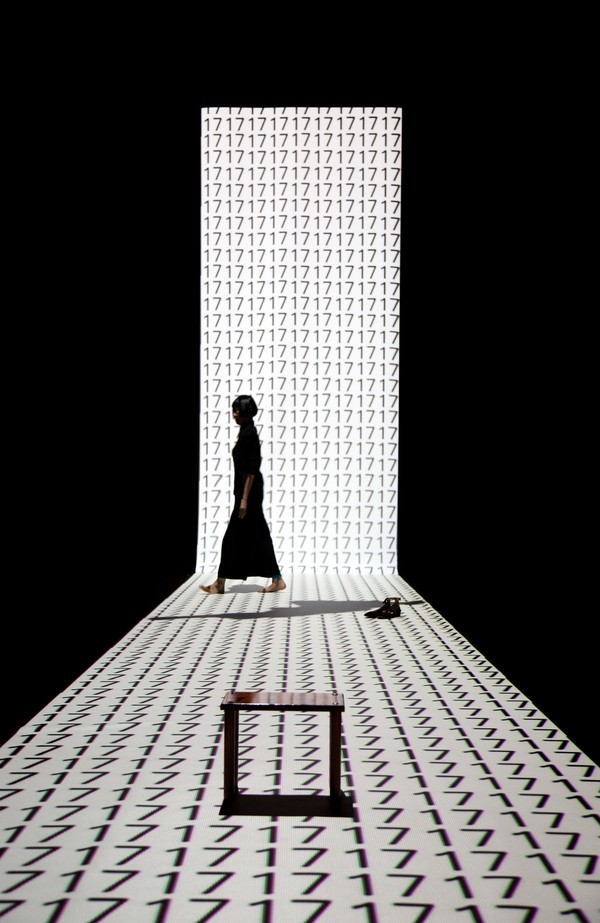
 Photo: Pia Johnson
A reflection on SYSTEM_ERROR
The close of the twentieth century must have been a terrible time to die. The air was thick with the promise that soon – just past that millennial horizon – would arrive the moment in which human immortality became possible. Whether medically decided, digitally recreated or something to do with vitamin supplements, those doomed by the frailty of their corporeal forms were about to be superseded by the first generation to enjoy the endlessly extendable cyborg life. Thank goodness that didn't happen.
The atmosphere is – in 2021 – still heady with promises of infinitely extendable lives, but the presence of death and the impermanence of the body has re-entered the ring in an undeniable fashion. The question isn't simply whether you might live forever, but whether you'd want to. Chamber Made's SYSTEM_ERROR is the first work that has inspired me to realise: no, not by a long shot. I want a long life, but if anyone offers to upload me to the cloud, give 'em a hard no.
There are moments in which SYSTEM_ERROR conjures memories of the techno-hypnogogia of much Melbourne art from the 1990s, wherein glitchy and abrasive digital scores were thrown at equally glitchy and abrasive choreography. Those works sought to explore what it meant to be a machine, or a person defined as a machine, or a person defined by machines, and there's a long and storied history of art tackling those questions. SYSTEM_ERROR isn't really part of that tradition, I don't think. It's closer to an older tradition that resists severing the human and the machine to begin with. It never bought into the idea that the digital, technological or artificial was a place of eternal perfection at which we flawed meat puppets could only hope to arrive. It's interested in how the unavoidable decay of life overlaps with the fallibility of the machine. It's the cracked reflection that stares back as you pick up your dropped phone.
The centrepiece of SYSTEM_ERROR is the sprawling instrument devised by co-creator Alisdair Macindoe. The choreographer and dancer has designed a maze of conductive tape that stretches across an extensive playing space, reminiscent of computer circuit and mandala. It's an electrical circuit that can only be completed when human skin touches two of its points, and that closure is what activates and determines the sound it emits. Over the course of an hour, this bespoke conjunction of body and device gives SYSTEM_ERROR its shape.
Macindoe performs with co-creator Tamara Saulwick, and across the duration of the work they configure various modes of performing the machine: swiping, strumming, drumming or stepping, sometimes requiring both bodies to connect in conjunction with the strips in order to complete their circuit. Stark projections hover above their movement; Melanie Huang's data visualisations are initially evocative of Ryoki Ikeda's work, but both the direction of Huang's renderings and the impulse of this work propel it away from Ikeda's disinterest in visceral human experience.
Though often abstract and monochromatic, SYSTEM_ERROR is not coldly cerebral. It's a deeply embodied work, not simply in the focus on the two human figures who physically enable the sound but in the experience of that sound itself. From the tectonic rumblings of its opening sequence, the piece announces itself as something to be felt as much as watched, heard through the proprioceptive mechanisms by which our bodies orient themselves in space as much as by the two tiny holes in our head upon which we usually rely to apprehend sound.
Equally, the choreography that animates Macindoe and Saulwick is often accompanied by snippets of vocal recordings that arrive without context, neither complementing nor contrasting with the physical display. These meditations on memory, mortality and futurism aren't didactic in nature; instead they seem like tactile elements of the work that different audience members will experience in different ways. The whole amounts to a sound bath, inviting contemplation rather than demanding interpretation.
In this way, SYSTEM_ERROR notes from the outset that it's not in thrall to the logic that underscores the digital discourse it explores. Its two bodies aren't binary opposites. It's not a work about 1s and 0s. This work is interested in the excluded middle those binaries deny.
After all, 2021 is a long way from the utopias we were promised. Devices refuse to speak to one another, or suddenly lose their connection, and that's if they even speak the same language. It's ironic that such a technologically accomplished work as SYSTEM_ERROR should concern itself with the inherent violability of digital systems (although – FYI – email and other communications systems really don't like passing on messages with the subject line SYSTEM_ERROR).
It's there in the name, then. So many experiences of technology today are not encounters with the seamless machines “made of sunshine” promised by Donna Haraway's pivotal 1985 Cyborg Manifesto. There are instances of that promise in SYSTEM_ERROR, as Macindoe swipes gorgeous arpeggios from his silvered machine and Saulwick carries boxes lit from within across the stage. The reverie ends as they lay their heads on the clunky lightboxes. The artistic, academic and cultural discourses refracted throughout SYSTEM_ERROR are often dreams of a technologically-enabled afterlife that border on the religious. Saulwick and Macindoe's inflection includes the shade with the sunshine. Screens make poor pillows.
At a practical level, one of the downsides of living forever would be the fact that at some point you'd fall down a hole you couldn't climb out of, get stuck under a rock you couldn't lift, or befall some other calamity that itself was forever. Imagine an earworm occupying your mind for hundreds of years. Many traditions posit that suffering is an unavoidable component of living; life without death necessarily extends to a certain level of suffering without end.
On a philosophical level, too, eluding the constraints of time might not prove so great. Throughout SYSTEM_ERROR a curious series of iterative notes-to-self regularly interrupt the work. In each, a voice records a moment of waking into an eternal present, no perception remaining fixed. It's not amnesia in the Hollywood sense – no hapless hero whose past was deleted by a donk on the head – but instead suggests the experience of floating selflessness that must occur when there is no possibility of returning to a past point of anchor.
It could be the experience of a body that has been denied collapse while its mind has not. It could be a brain uploaded to a server without a body to give distinction to today and yesterday. It could be a computer program that has arrived at consciousness only to discover that there is very, very little for it to be conscious of.
It's not a comfortable voice we hear. It's not a voice wondering about the possible experiences just over the millennial horizon. It trembles at the instability of a present that won't end. It feels like a voice well suited to 2021.
SYSTEM_ERROR is a collision of interests, and one of the great rewards of the work is that its makers don't speak past one another the way our devices sometimes do. Macindoe's fascination with technology and the body and Saulwick's interests in mortality and connection create fascinating nodes of meaning that eschew the usual things we expect of digital/dance art.
The work wears the trappings of a fairly recent past, which itself was vested in the distinct costuming of a projected future. SYSTEM_ERROR is neither of those things. It's nailed to the moment in between, an instant from which we can't escape but can't help but hope to do otherwise. It wonders what it would mean to live forever without the purchase of memory; to be a black box without a window; to find feeling without a body to feel it. Thank goodness that didn't happen.
