Labours immaterial and a feeler’s guide to knowing
In my backyard, a spider scuttles from my movement. The growth in the passionfruit vine snakes along the fence. The sunshine is dappled by the Lilli Pilli tree, and I sense the warmth on my back. Five junior female blackbirds balance on the fence before lifting oA and soaring over the rooftops. It is moments like these that I feel most like me. I was feeling like me when the invitation to perform the writer in residence for Hi-Viz 2023 came in. I felt it land deeply into that part of me that is rich with experience of performing, directing, and curating experiences. I felt honoured and excited. As a fulltime academic, it was enticing to be invited to hang out with creatives who are thinking about making art and who spend their time in the embodied and digital practices of the performing arts.
Art is large and it enlarges you and me. To a shrunk-up world its vistas are shocking. Art is the burning bush that both shelters and makes visible our profounder longings (Jeanette Winterson) (1)
Hi-Viz 2023 is located within the grounds of the University of Melbourne in the infamous Market Hall in the distinctive Art Deco Building 189. There is a weather anomaly on this day and as I step oA the tram, a hot dry wind gusts and darts about me. The streets are quiet with the absence of semester break, yet the potential of the day looms large. Like the junior blackbirds from my backyard fence, a group of participants teeter on the edge of the courtyard. We are the happening that happens before the doors are thrown open. Inside, Auntie Janet welcomes us to the lands of the Wurundjeri people. We have begun.
At one point, I stand alongside someone younger than me, yet not so young as to be youthful. They speak softly to no one, to me, to themselves when they say, ‘I am so glad I came, I really didn’t want to come, I almost gave up, but now that I am here, I am glad I came, I am so glad I came.’ It seemed as if their heart would explode with gladness, that something so profound that they had kept below the surface and not dared look at during long and busy and un/productive days could finally shine. In the gladness expressed there was an acknowledgement of some deeply felt longing that somehow transformed on arrival. It is in this place, that is only a place because of the others we are with, that we fully feel what we know. Longing is transformed into belonging. We recognise what others know in their bodies. Our shared knowing is evident in and through how we relate. Carefully selected exercises, deliberate questions, set down a pathway down which our knowing may wander while at the same time seek connection. The potential of collaboration is activated as we stand alongside, feel, listen, and hear one another. We feel beyond one another, beyond the architecture, back in time to connect with country, with nature, with creative intent. How wonderful to notice body as it feels and recognises this; where the gladness we feel; can shift around the body and compel participation.
I experienced Hi-Viz 2023 through the lens of some research and practice I have been immersed in over the past few years. A deliberately political space in which immaterial labour is acknowledged. I have been thinking about the remarkable eAort of artists in recent years and of how determined we are to make the world better through our art practice. Immaterial labour is that labour that is intangible yet essential to a vibrant arts sector.
The labour of dreams.
The labour of networking.
The labour of risk taking.
The labour of fundraising.
The labour of failure.
The labour of getting back up.
The labour of work arounds, of multi-task mothering and of creative practice.
The labour of asking for help, of borrowing, and of support.
The labour of outside eye, proof reading, social media, casting, acquitting, get ins, shoulders to cry on, opening night drinks, and offering lifts.
That labour that is immaterial, invisible, unfunded.
That labour of trekking instruments from home to car, from car boot to venue which I imagined that vocalist Gelareh Pour did, perhaps all by herself, to haul the complex array of instruments that she set out as she created a space within which to perform her take on neo-Persian Experimental music, originating from Iran. Installed in the centre of the wall with the elongated honeycombed windows at the north end, each instrument was removed from a well-loved suitcase and laid about on the floor, encircling a simple folding chair. Next came a music stand, a loop pedal, and a large amplifier. Finally, Gelareh’s voice – layered with years of practice, with embodied knowledge of craft and culture. We were a willing audience, forming another layer of encirclement for this installation and living witnesses to Gelareh’s performance of listening.
Pauline Oliveros (2) has long spoken about deep listening in relation to composers and the way their practice over time leads them to ‘expand the perception of sounds to include the whole space/time continuum of sound—encountering the vastness and complexities as much as possible.’ The mystery of this performance was not so much the intercultural or the virtuoso, although both were palpable, it was the intimacy of witnessing the way in which Gelareh listened to herself and to us; a listening that was inclusive and that honoured both her and all of us.
In this experience of listening together, I thought about the team who set about planning the program for the day. A program is not just a schedule that list the things that will happen across time. It is a vessel. A container. It is also a map or pathway. Something to bring us into the room and something to wrap around all who come along. A structure from within which we might improvise, expand, and contribute. As Twyla Tharp reminds:
before you can think out of the box, you have to start with a box (3)
Layered into the day was a force; momentum and intention that flowed from the Hi-Viz Satellites LAB; a practice exchange that was held in the same space over the preceding four days. Coming in on the tail end of this important work, a partnership between Melbourne-based Chamber Made, Punctum Inc from regional Victoria and SAtheCollective (Singapore), was like surfing a wave.
The energy toward thinking outside the box was charged. I found it particularly so when I joined Alex Walker from House of Muchness in a morning masterclass, only to discover a group of SAtheCollective artists in the same workshop. Striking from the outset, Alex was generous and insightful in the way she unfolded the values and practices that underpin her facilitation work with young people. Through simple modelling, we participated in the House of Muchness methodology. A box of its own making, crafted over many years and refined under pressure during the lockdowns in Melbourne due to covid-19 across 2020 and 2021. Just like Tharp’s literal ‘box’, the tangible impact of the magic imbued in Alex’s methodology, reinforced the immaterial labour in our ephemeral arts practices. Live performance or improvised process, the creative and inclusive practice of House of Muchness tackles youth development head on. Structured around six aims, Alex’s approach values the immaterial from 1. Chat and snacks, to 2. ritual activities such as repetitive games like ‘I am…’ or ‘yes, no, maybe’ to skill building through 3. The stick game transition into what House of Muchness calls 4. Sanctuary, a chance to reinforce the trust in the group and in the working practices before diving into 5. The Public Way (or inner group to outer audience). 6. The End.
I can vouch for the snacks; they were delicious, with nut free and gluten free options. Across the two hours the individuals in the room became a group and conversations turned to the challenges of parenting teens to the creative lives of participants such as the recent film debut of Shadya by Nora Niasari. It was as if we were weaving – drawing actual fibre strands through and across as we participated in House of Muchness activities Connections were made, stories were shared, and feelings were felt. I love the way embodied practices of music, dance and drama set down pathways to the interior. It is one thing to think thoughts and to speak words, and another to express emotion and connect socially, but when we turn our attention to our interior, to how what we are sensing feels, there is a kind of restoration of self.
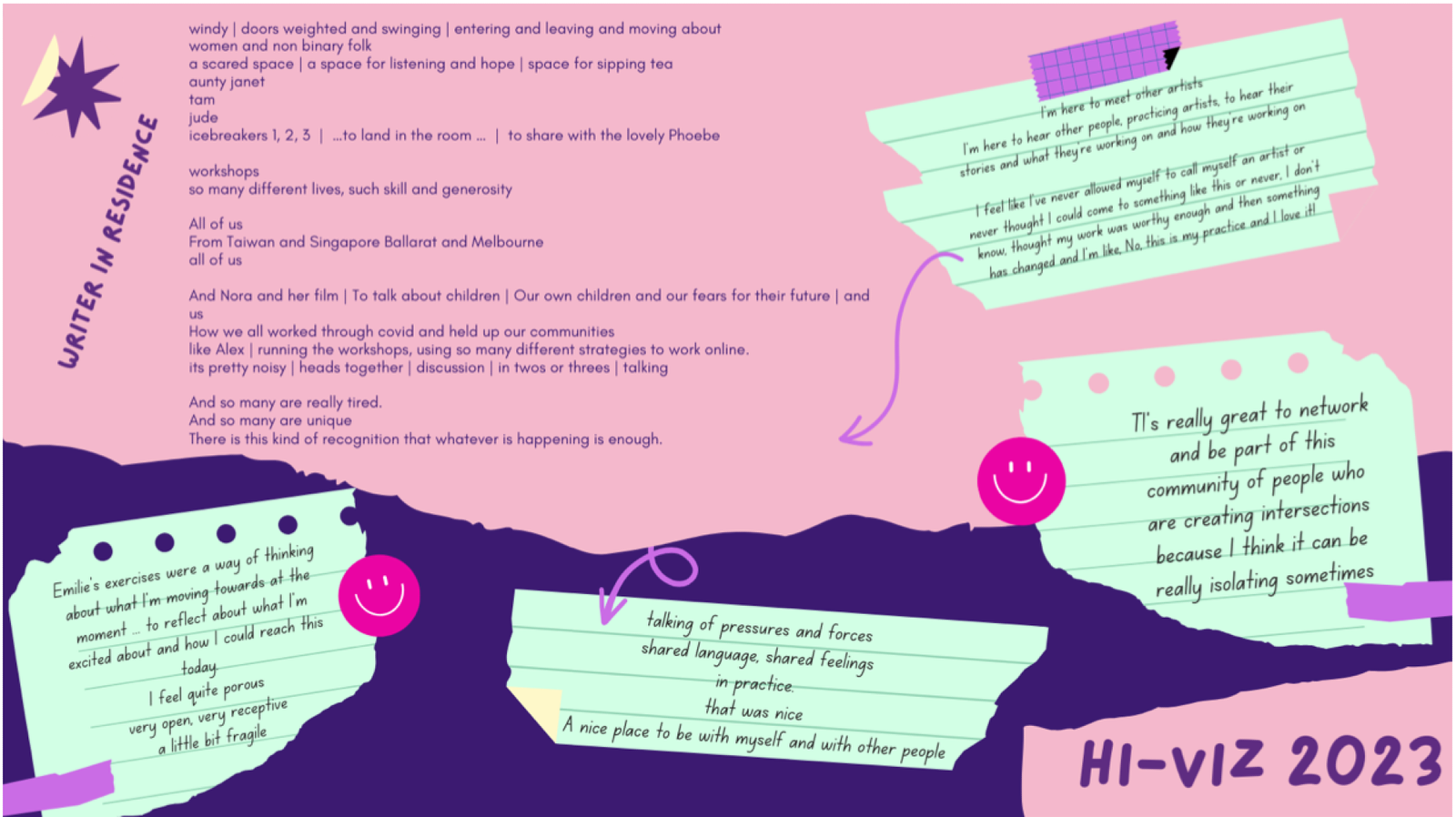
I noticed the many selves of delegates and their degrees of restoration across the day. I observed how people shifted from social unease or anxiety where the need to know why I am here matters, to being within what was unfolding and finding oneself somewhere new. The register of responses to questions late in the day, such as ‘What do you need?’ were not focused on productivity or resources so much as states and sensations.
- To make space
- To be like water
- To check in with myself
- To walk more
- To embrace imperfection
And when asked ‘What do you have’? participants championed immaterial qualities such as persistence, healing, play, joy, humour, change, and being among women. For some, their state of fatigue dominated while for others the desire to resist, to advocate and to rebel remained essential.
I enjoyed the people in the room during this part of the day. While there was a kind of focus on words that we were invited to speak out, phrases that were heard and scribed, and colourful post-it notes that were then added to a wall of longing, the invitation from Jude unfolded a kind of choreography. Bodies moved and flowed around the room, heads bobbed up and down, forms stooped over pages sprawled on the floor, others circumnavigated around stationary bodies – taking up and then releasing shapes, in brief encounters and momentary meetings before melting away in a dance of nonproductivity. An ebb and flow of inclusive agency. A ritual of intuition.
It was no accident that the end of the day arrived here. Arising from the care taken to convene a diverse women and non-binary event and the collective coming together of presenters and participants. The Hi-Viz form embodies what Sarah Pink (4) refers to as a sensory approach with a moral integrity where practical and ethical elements are interlinked. Where we co-create an environment in which we can be like gardeners whose knowledge is evident only in the way they interact with plants. It is in our practice, not in our talk, that we speak the loudest and listen with greatest intimacy. Pink draws on the thinking of humanist geographer Porteous, when she says that to ‘live well we need to improve the current imbalance of our sensory modalities,’ where reliance on our vision serves to alienate us from one another and our surrounds.
(1) Jeanette Winterson, quoted by Ann Bogart 2001, p1. A Director Prepares.
(2) Pauline Oliveros 2005 p14; Deep Listening: a composer’s sound practice.
(3) Twyla Tharp 2003 p 78; The Creative Habit: Learn it and use it for life.
(4) Sarah Pink, 2009 p59. Doing Sensory Ethnography, Sage.