 Photo: Bec Fary
this time around
“Where is your breath taking you?” Becky Sui Zhen, from ‘Living Memory’
I smell yesterday’s breath (I should’ve washed this mask). My in... and ex... -halations are hot then wet then cool against the fabric, then against my skin, then against the fabric again.
My breaths are
vapor, then moisture,
then vapor, then moisture,
their closeness creating plosives inside my ears.
My mask is an amplifier. My footsteps boom. My heartrate flutters and chokes. My safety barrier to the threat of ‘outside’ also holds me in. I see a loose thread at the ridge of my nose and my perception recedes to the few millimetres between my skin and the cloth.
Air breaks through this mask-membrane.
In the home-yoga videos they always tell me to
take the deepest breath you’ve taken all day...
and
release.
I pull the outside-air through my nose and my chest expands with inside-air.
My perception widens. The thudding of my internal sounds recedes and I can listen-out again.
“Panting a little as I start to climb the ridge up to where the wind is a little wilder.” Fayen Ke-Xiao d’Evie
I re-turn left and return to the street behind my house, the one that runs along the railway line. I veer right towards that familiar trickle — I’ve heard this water before and I’ll hear it again. It’s going to rain tomorrow, this place will be louder then. Today, it’s quiet.
I’ve revisited and revisited this place, edging closer each time until I had the courage to hop the tiny fence and peer into the underground shadow.
Huh. It’s a stormwater drain.
“I’ve come to know this country more intimately... collapsing the site of making to this valley... collapsing the materiality to my own body, and to the living and the non-living plants and animals and winds and rain here on Jaara country that keep me company as I work.” Fayen Ke-Xiao d’Evie
For the months (or, has it been a year? a week?) of lockdown, I’ve intensified my local noticings.
With fluctuating levels of restrictions, my risk aversion (and, it has to be said, my ability to work largely uninterrupted from home) led to a mostly stable, quiet routine. I entrained to the refrain:
wear a mask
don’t touch anything
wash your hands stay home
Aside from walking and biking the familiar, I repeated my wearamaskdonttouchanythingwashyourhands- stayhome mantra regardless of the state’s lockdown level. The daily actions of my small local life layered themselves into habit.
Deep breathing, repetitive movement and attentive listening became ways to reconnect with place, reminders of my ‘home’ in the local ecology. Reminders that broke through isolation-barriers that had blocked my access to anything ‘outside’ (or, external to ‘me’).
But my staying-home now feels out-of-sync.
“Just figuring out what I can do differently this time around.”
From a late-night voicemail message included in an audio sketch by Roslyn Oades
This ‘time’ of day or night, this ‘time’ of life, this multidimensional ‘time’ of 2020, or this here-and-now/there-and-then moment in ‘time’. This ‘time’ is a many-layered time. For me, here-and-now ‘time’ is November 2020, in so-called Footscray on Woi Wurrung and Boonwurrung country. Now (as I’m writing this, and I hope it’s still so when you’re reading it) the Covid transmission rates in this state are low, hovering at 0 for some weeks and lockdown restrictions have recently eased. But my body carries caution that I can’t shake. The slownesses I’ve accumulated and reinforced over this year are in conflict with what feels like an overwhelming reopening of geographies, social connections and possibilities.
Memory of viral danger is overlaid on present safety and impeding future movement. I carry muscle memory of precaution and anticipation of further virus transmissions. I find myself unable to settle into here, now, the live reality of consistently low transmission rates in Victoria that are again reframing ‘safety’ and what it means to be moving locally outdoors. Leaving home, once a familiar, meditative motion, is fraught. The barriers between me and ‘outside’ are clouding over again.
I need to reorient myself in time and space.
“I’ve committed to a practice of walking Jaara country at sunrise and sunset. It’s a study of noticing the shifts in the plants, their growth and flowering and decay and dormancy.” Fayen Ke-Xiao d’Evie
I walk at sunrise and sunset — times when I can listen to shifting rhythms of waking-up or slowing-down. And I walk at midnight and midday — times when the neighbourhood is relatively static. Each day, each step, holds memories of those that came before, and anticipates the next. Through repetition arises familiarity. Through familiarity arises the ability to notice anew.
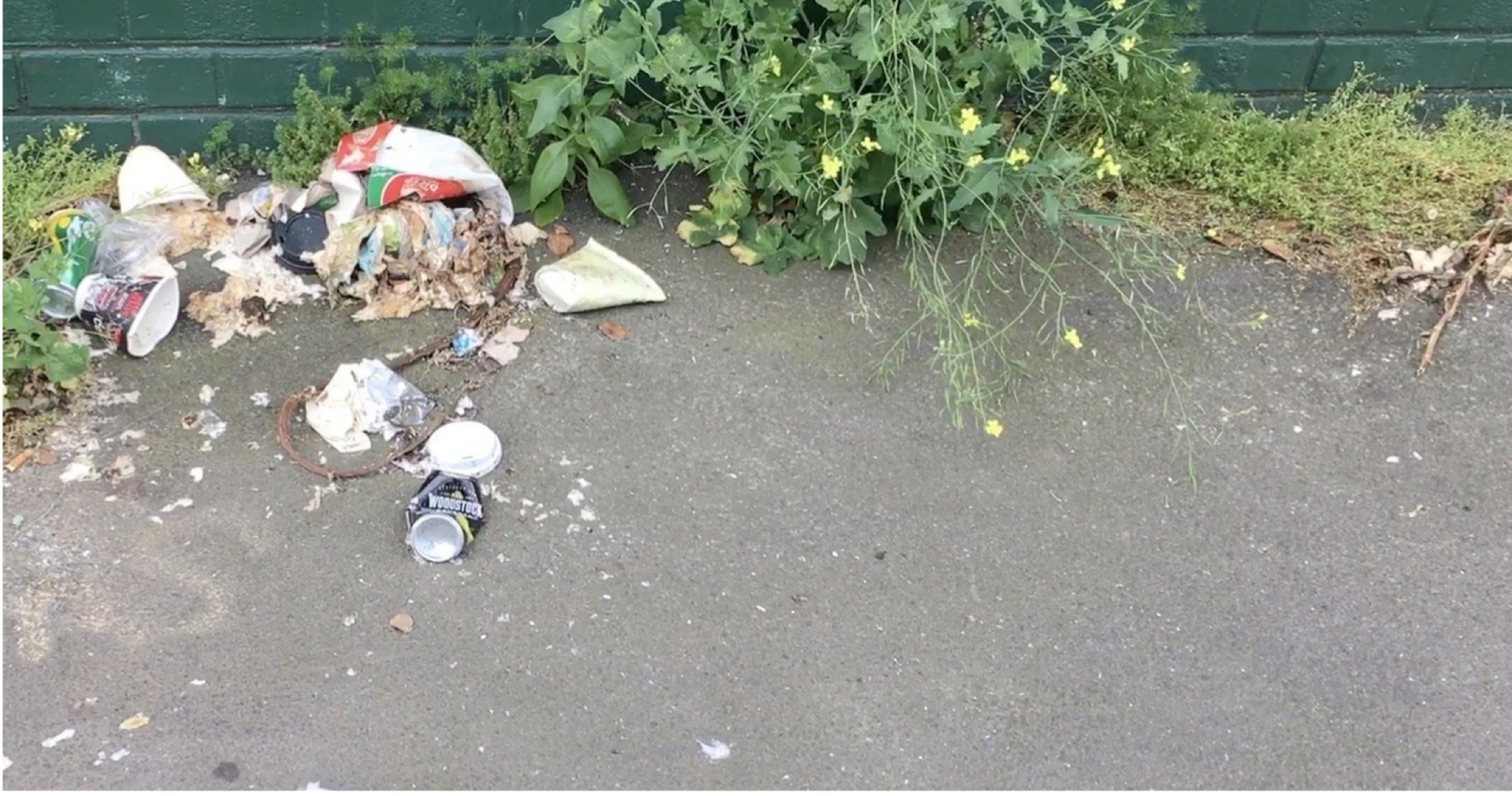
In an alleyway I’ve walked countless times, I reach to record a video on my phone and only then notice the security camera. I watch a discarded coffee cup draw a perfect circle, pushed by the wind. I listen with the murder of crows that seem to live in the large tree above a carpark.
For me, local movement is embodied thinking-through, processing internal and external realities. Held back (perhaps counterintuitively, though I know there are plenty more still staying home) by the easing of restrictions, I nudge myself out of the safeties of home into the outside.
“One step after another. One foot moving into the future and one in the past. D’ya ever think about that? It’s like our bodies are caught in the middle.
The hard part is staying in the present, really being here, really feeling alive.” Janet Cardiff, from ‘Her Long Black Hair’
Using two lapel microphones, one clipped to the inside of my face mask and the other attached to the outside of my clothing, I record myself walking local loops: from my house, around the block and back again. At midnight, sunrise, midday and sunset, I listen to my human and more-than-human neighbours, alongside the sounds of my breathing, my footsteps. Mic cables click as they hit the headphone cord with each step. Recording inside and outside my mask, I listen locally — to local place, and to the localities of my body — and try to realign myself with my neighbourhood.
I zoom in on my fluctuating fears, noticing when my too-close breath is shallow, or when I have room for depth. I hold fears with memories of caution, hold curiosity with mindful presence, try to find calm in releasing anticipations of unknowns — and begin to realise there’s safety and threat on both sides of my mask. This time around post-lockdown, this time around the block, this time around the day, what things might I do differently? What shifts might I notice?
On the webpage (a ‘digital sketch’) where I present these sounds, I re-listen to my walk-recordings and I return. In the layered looped listenings, hearing oscillations of inside-outside air, I register familiarities, avoidances, startlings, uncertainties, hurryings, decelerations. To me, each recording holds the memory of the first and the anticipation of the last, and those in-between — pasts, presents, futures combined in this time. Around and around.
---
While I mention my ‘home’, I acknowledge that I’m an uninvited guest on stolen land. This Time Around was made in so-called Footscray, on land that belongs to Wurundjeri and Boon Wurrung peoples of the Eastern Kulin Nation.
I pay my respects to their Elders, past, present and emerging.
This always was and always will be Aboriginal land.